
Category: Reflections

  • Encountering a King!


    I can’t be the only vicar preparing to think about Christ the King, whose mind automatically springs forward to the pending Coronation of Charles III in 2023.  Whilst it would be tempting to start thinking about all of the things that we should and could do to celebrate with our nation and pray for our new king, my own challenge this particular weekend is actually to prepare resources and teaching for our Young Church.  My memory of these sorts of things in the past is that we easily default to just making crowns – but I wonder if that’s the right thing to do?

    When people think of kings and rulers, of great leaders, they often think of either the great men and women they learned about at school, or those they have learned about on the news.  The challenge for the Church, is that we follow a king that does not conform to earthly expectations or role models of kingship, of what it means to lead and rule, and that is both difficult but also wonderfully inspiring.

    Christ the King, as we keep the feast day this Sunday (20th November) is a day when we remember that the first step of leadership and power, is to serve.    As we shall sing in our service:

    From heav’n you came, helpless babe,
    entered our world, your glory veil’d,
    Not to be served, but to serve,
    and give Your life that we might live.

    This is our God, the servant King,
    he calls us now to follow him,
    to bring our lives as a daily offering
    of worship to the Servant King.

    How do we go about both teaching that to our youngest members and modelling it to the world? If I am honest, I think we mostly get it wrong.  The church is a powerful institution, of which our Priory is a part.  Leaders in the parish are also powerful people, myself especially.  So I am very glad of the opportunity to be taking the time to serve our youngest members this Sunday morning, and it makes me wonder if the stereotypical craft activity of having children make crowns for Christ the King might miss the point.  I wonder if, perhaps, you might take a moment to ask them (over post-church coffee) what they have discovered it really means for Christ to be our King, if it’s more than just wearing a crown.
  • What is a PCC and Why might I want to be involved?


    What is a PCC?

    A parochial church council (PCC) is the executive committee of a Church of England and consists of clergy and churchwardens of the parish, together with representatives of the congregation.  Every PCC is also a Charity and so it’s members are also trustees.

    Legally the council is responsible for the financial affairs of the church parish and the maintenance of its assets, such as churches and church halls. It also assists the clergy in the management of church affairs in the parish, and promoting the mission of the church. The PCC also has a voice in the forms of service used by the church and may make representations on matters affecting the welfare and pastoral care of the parish.

    The makeup of a PCC is set out in the Church Representation Rules. To be an elected representative of the congregation, a person must be a communicant, aged 16 or over, and must have been on the church electoral roll for at least 6 months unless under 18, they must be nominated and seconded by persons on the roll.

    Lancaster Priory PCC meets 10 times a year. There is a list of current members in the porch of the church and the minutes of the meetings are publicly available (on request) after the have been approved by the PCC.  The PCC delegates areas of work to the following subcommittees: World and Community Group, The Resources Group and The Property Committee.  They also plan to launch a new Social and Fundraising Group and an Eco Group in the coming year.  The membership of these groups is wider than PCC members and they meet with different frequency depending on their delegated tasks and projects.

    Why might I want to get involved?

    Whilst PCC meetings include lots of different things, one of the most exciting things that they do is to help discern and respond to God’s call for the church, parish and use of it’s resources.  Lancaster Priory has four particular strengths through which the PCC can describe it’s ministry and outreach. We believe these form a core part of our identity, gifting and calling. They are:

    A- Worship

    B- Christian Education

    C- Community, Compassion and Kindness

    D- Innovation, Creativity and Commerce

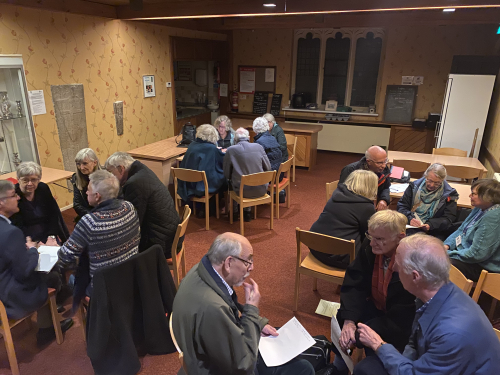
    Alongside these four broad areas, our PCC have been discerning what God might be calling us to prioritise in ministry for the next 5-10 years, they have identified four priorities.  In the photograph above, you can see the PCC discussing at their October meeting, the next steps of the process on four key areas:

    One: Inspiring new generations.
    Although Lancaster Priory has an able and committed core of lay people, these are largely drawn from amongst the retired. Those of a working age are often more peripheral to the life of the church. University students can struggle to make links with the rest of the congregation. As the Priory emerges from the pandemic, it is clear that the work of evangelism and mission with children, young people and their families has suffered. There is a strong cohort of choir families who are committed to the priory but not necessarily well integrated into its life and ministry. We long for the Priory congregation to become broader and more diverse, better representative of our parish and city.

    Two: Growing deeper roots on the Marsh.
    The Marsh estate, which is amongst the more deprived areas of the city, comprises almost 1/3rd of our parish population along with the neighbouring new Luneside development and is largely unreached by the church. We believe we are called to invest in evangelism and mission in this part of our parish, to plant new congregations, as well as continuing the work of supporting families and young people and offering friendship to the elderly. We believe that we have been called to witness through word and service to proclaim the message of God’s unconditional love on the Marsh.

    Three: A Resource for the City, Diocese and Region
    The Priory has a recognised role within the city and region as a civic church. The annual pattern of civic engagements that come from universities, schools, city and county continue to be significant but we believe that we are called to develop a distinctive Christian voice within these relationships. The Priory is recognised as a significant and distinctive church within the diocese, but has not historically done much to resource other churches. We believe we are called to be a place of teaching and learning that empowers the people of God in a way that will benefit the whole diocese, and we seek to develop new ministries in this area.

    Four: Caring better for God’s Creation
    Lancaster Priory has been among the pioneers in Creation Care in Blackburn diocese, holding an ‘A Rocha’ Bronze EcoChurch award. We are fully committed to the General Synod 2030 net zero carbon target, use the Energy Footprinting Tool and Parish Buying Energy Audit. Recognising the crucial significance of the next five years in global efforts to prevent catastrophic climate change, we are committed to doing all we can at church and in our own lives to protect God’s creation, and acknowledge the generosity of God in his Creation.

    The next PCC elections will be in May 2023 – could God be calling you to participate in mission and ministry as a PCC member in this next stage of mission and ministry?